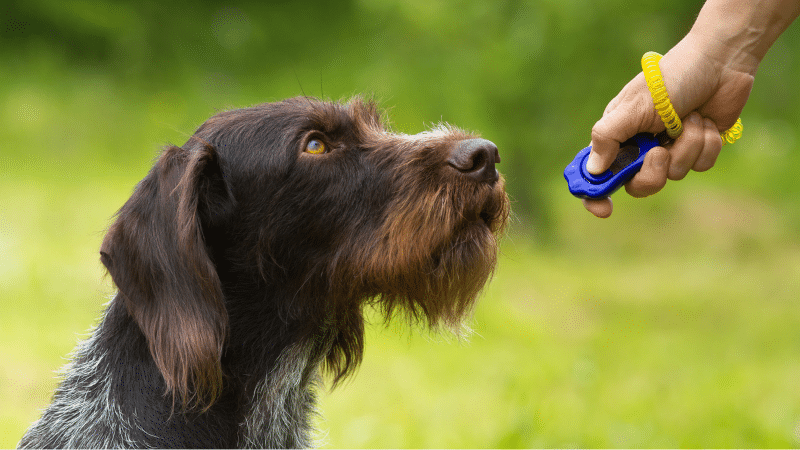
Clicker training has been around for decades, but it still raises eyebrows among dog owners who have never tried it. A small plastic box that makes a clicking sound — how could that possibly teach a dog anything? The short answer: remarkably well. Used correctly, dog clicker training is one of the most precise, humane and effective methods available, and it works on everything from a nervous rescue to an energetic puppy.
What Is Clicker Training?
Clicker training is a form of positive reinforcement dog training built around one simple principle: mark the exact moment your dog does something right, then reward it. The clicker acts as a “bridge signal” — it bridges the gap between the behaviour and the treat, telling your dog with pinpoint accuracy that that specific thing is what earned the reward.
Without a marker, timing becomes your biggest enemy. By the time you have reached into your treat pouch, your dog has sat, stood up, scratched an ear and looked away. What exactly were you rewarding? The clicker removes that ambiguity. The click is fast, consistent and unmistakable — and unlike your voice, it never changes tone depending on your mood.
The Science Behind It
Clicker training is rooted in operant conditioning — specifically the work of B.F. Skinner, later applied to animal training by Karen Pryor. When a behaviour is followed by a positive outcome, the animal is more likely to repeat it. The clicker accelerates this process by making the connection between behaviour and reward crystal clear.
The click also becomes what is known as a conditioned reinforcer. Initially it means nothing to your dog. Once you have paired it with treats enough times, the sound itself becomes rewarding — it triggers the same anticipation as the treat arriving. This is called “charging the clicker”, and it is the essential first step before any formal training begins. You can read more about the underlying principle in this overview of clicker training.
How to Charge the Clicker
- Click once, then immediately deliver a small treat (within one to two seconds).
- Repeat 10 to 15 times per session, with no commands or cues.
- Your dog does not need to do anything — you are simply building the click-treat association.
- After two or three short sessions, your dog will perk up the moment it hears the click.
What Can You Teach With a Clicker?
Almost anything. Clicker dog training is particularly effective for:
- Basic obedience — sit, stay, down, come and heel.
- Trick training — spin, fetch, wave and roll over.
- Behaviour shaping — building complex actions one small step at a time.
- Loose-lead walking — marking the moment the lead goes slack pairs beautifully with structured leash training for dogs.
- Confidence work — rewarding a shy dog for brave choices, which is why the method suits fearful and rescue dogs so well.
A Simple Way to Start
Once the clicker is charged, teach “sit” to prove the system to yourself. Wait for your dog to sit naturally, click the instant its bottom touches the floor, then treat. Repeat. Within a few sessions your dog will start offering the sit deliberately — that is the moment you add the verbal cue “sit” just before it happens. The clicker marks; the treat pays; the cue names the behaviour.
Common Mistakes to Avoid
- Clicking too late. The click must land at the exact moment of the behaviour, not after. Timing is the whole game.
- Clicking more than once. One click, one behaviour, one reward. Multiple clicks muddy the signal.
- Forgetting the treat. Every click must be followed by a reward, even if you clicked by accident. The click is a promise.
- Marathon sessions. Keep it to five or ten minutes. Short and frequent beats long and tiring.
These overlap with the wider common dog training mistakes that slow progress for many owners.
Do You Have to Use the Clicker Forever?
No. The clicker is a teaching tool, not a lifelong crutch. Once a behaviour is reliable and on cue, you fade the clicker out and move to intermittent, real-world rewards — praise, play, a favourite toy or the occasional treat. The clicker simply gets the behaviour installed quickly and cleanly. Many owners keep one in a drawer for teaching new tricks and leave it there the rest of the time.
Is Clicker Training Right for Your Dog?
If your dog can hear and enjoys food or play, clicker training will work. It is gentle enough for a timid puppy and precise enough for advanced tricks, which is why it suits early puppy socialisation and training just as well as it does adult dogs. Deaf dogs are the one exception — they respond to a visual marker such as a thumbs-up or a torch flash instead, using exactly the same principles.
So, do dog training clickers work? Absolutely — provided your timing is sharp and your rewards are consistent. It is not magic; it is clear communication. And clear communication is the foundation of every well-trained dog.