Unleashing the Power of Dog Training Clickers: Are They Really Effective?
Are you tired of struggling to communicate with your furry best friend? Have you tried various training methods but still haven’t seen the desired results? Look no further! In the world of dog training, there is a powerful tool that has been gaining popularity – the dog training clicker. But you might be wondering, are they really effective? In this article, we will delve into the fascinating world of dog training clickers and explore their true potential in transforming your canine companion into a well-behaved and obedient pet. From understanding the science behind clicker training to uncovering success stories from dog owners, we will leave no stone unturned. So, if you’re ready to take your dog’s training to the next level and unleash their full potential, keep reading to discover the untapped power of dog training clickers. Get ready to witness a remarkable transformation in your four-legged friend’s behavior and create an unbreakable bond like never before.
How do dog training clickers work?
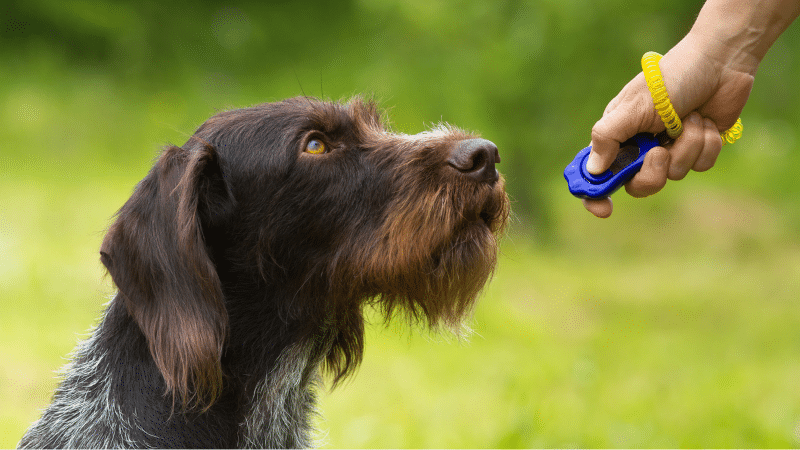
Dog training clickers work on the principle of positive reinforcement. The clicker is a small handheld device that makes a distinct clicking sound when pressed. This sound serves as a signal to your dog that they have performed the desired behavior correctly. Clicker training is based on the concept of classical conditioning, where the click becomes a conditioned reinforcer that predicts a reward.
Using a clicker allows you to mark and capture your dog’s behaviors in real-time, making it easier for them to understand what they are being rewarded for. The clicker bridges the gap between the behavior and the reward, providing immediate feedback to your dog. This instant feedback helps them associate the click with the desired behavior, making the training process more efficient and effective. With consistent use of the clicker, your dog will quickly learn to associate the sound with positive reinforcement, motivating them to repeat the behavior in the future.
Benefits of using dog training clickers
There are several benefits to using dog training clickers. Firstly, clicker training is a precise and clear method of communication. Unlike verbal cues or physical gestures, the clicker provides a consistent and distinct sound that is not influenced by tone of voice or body language. This clarity helps to eliminate confusion and allows your dog to focus on the behavior being reinforced.
Secondly, clicker training allows for immediate reinforcement. The clicker provides instant feedback, making it easier for your dog to understand which behavior they are being rewarded for. This immediate reinforcement helps to strengthen the connection between the behavior and the reward, making the training process more effective.
Another benefit of using clickers is that they are suitable for dogs of all ages and breeds. Whether you have a young puppy or an older dog, clicker training can be adapted to suit their individual needs. The clicker can be used to teach basic obedience commands, as well as more advanced behaviors and tricks.
Additionally, clicker training is a force-free and positive training method. It focuses on rewarding desired behaviors rather than punishing unwanted ones. This positive reinforcement approach helps to build trust and strengthen the bond between you and your dog. It also promotes a more enjoyable and stress-free training experience for both you and your furry friend.
Scientific evidence supporting the effectiveness of dog training clickers
The effectiveness of dog training clickers is supported by scientific research. Studies have shown that clicker training results in faster learning and better retention of trained behaviors compared to other training methods. One study published in the Journal of Applied Animal Welfare Science found that dogs trained with a clicker learned new behaviors faster and retained them for longer periods of time.
Clicker training is based on the principles of operant conditioning, which have been widely studied and proven to be effective in animal training. By using positive reinforcement, clicker training helps to strengthen desired behaviors while minimizing the occurrence of unwanted behaviors. This approach has been shown to be more effective and humane than punishment-based training methods.
Furthermore, clicker training has been successfully applied to a wide range of species, including dogs, dolphins, and even chickens. This demonstrates the universality and versatility of clicker training as a training method. The consistent results across different species further validate the effectiveness of clicker training in shaping behavior.
Training techniques and methods using clickers
Clicker training can be used to teach a variety of behaviors and commands to your dog. Here are some commonly used training techniques and methods:
1. Capture: This technique involves capturing and reinforcing your dog’s natural behaviors. For example, if your dog naturally sits down, you can use the clicker to mark the behavior and give them a treat as a reward. This helps to reinforce the sitting behavior and encourages them to repeat it in the future.
2. Shaping: Shaping involves breaking down complex behaviors into smaller, manageable steps. You can use the clicker to mark and reinforce each small step towards the desired behavior. For example, if you want to teach your dog to roll over, you can start by rewarding them for lying down, then for turning their head, and gradually shape the behavior until they complete a full roll.
3. Targeting: Targeting involves teaching your dog to touch a specific object, such as your hand or a target stick, with their nose or paw. You can use the clicker to mark and reinforce each touch. Targeting is a useful technique for teaching your dog to follow directions and perform specific actions.
4. Chaining: Chaining involves linking multiple behaviors together to create a sequence. You can use the clicker to mark and reinforce each behavior in the chain. For example, if you want to teach your dog to fetch, you can start by teaching them to pick up the toy, then to bring it to you, and finally to release it into your hand.
These are just a few examples of the training techniques and methods that can be used with clicker training. The key is to break down the desired behavior into smaller steps, use the clicker to mark and reinforce each step, and gradually build up to the final behavior. With consistency and patience, you can teach your dog a wide range of behaviors and commands using clicker training.
Common misconceptions about dog training clickers
Despite their effectiveness, there are some common misconceptions about dog training clickers that need to be addressed. One misconception is that clicker training is only suitable for young puppies. In reality, clicker training can be used with dogs of all ages and breeds. It is never too late to start clicker training your dog, and older dogs can learn new behaviors just as effectively as puppies.
Another misconception is that clicker training is time-consuming and requires a lot of effort. While consistency and patience are important in any training method, clicker training can actually save you time in the long run. By providing clear and immediate feedback, clicker training helps your dog learn faster and retain the trained behaviors for longer periods of time.
Some people also believe that clicker training is solely based on treats and that their dog will become dependent on food rewards. While treats can be used as a primary reinforcer during clicker training, they can be gradually phased out and replaced with other forms of reinforcement, such as praise or play. The clicker itself becomes a secondary reinforcer that predicts the reward, making it possible to fade out the use of treats over time.
It is important to remember that clicker training is a flexible and adaptable method. It can be tailored to suit the individual needs and preferences of both you and your dog. By debunking these misconceptions, you can embrace the true potential of clicker training and experience its many benefits.
Choosing the right clicker for your dog
When it comes to choosing a clicker for your dog, there are a few factors to consider. Firstly, you’ll want to make sure the clicker is comfortable to hold and easy to operate. Look for a clicker that fits comfortably in your hand and has a distinct and consistent click sound.
Additionally, consider the durability of the clicker. Dogs can be rough with their toys, so you’ll want a clicker that can withstand some wear and tear. Look for a clicker made from sturdy materials that can withstand the occasional drop or chew.
Furthermore, some clickers come with additional features, such as a wrist strap or a built-in whistle. These features can be useful for keeping the clicker within reach at all times and for adding variety to your training sessions.
Ultimately, the right clicker for your dog is the one that you feel comfortable using and that your dog responds well to. It may take some trial and error to find the perfect clicker, but once you do, you’ll be on your way to successful clicker training.
Step-by-step guide to using a dog training clicker
Now that you have a better understanding of how dog training clickers work and their benefits, let’s dive into a step-by-step guide on how to use a clicker to train your dog:
1. Get your dog familiar with the clicker: Start by associating the clicker with positive experiences for your dog. Click the clicker and immediately give your dog a treat. Repeat this several times until your dog starts to make the connection between the clicker and the reward.
2. Choose a behavior to train: Decide on a specific behavior or command that you want to teach your dog. It’s best to start with simple behaviors and gradually move on to more complex ones.
3. Capture the behavior: Wait for your dog to naturally perform the behavior you want to train. As soon as they do, click the clicker and give them a treat. Repeat this several times to reinforce the behavior.
4. Add a cue: Once your dog is consistently performing the behavior in response to the click, you can add a verbal cue or a hand signal. Say the cue or make the signal just before your dog performs the behavior, then click and reward them. Repeat this process until your dog starts to associate the cue with the behavior.
5. Shape the behavior: If the behavior you want to train is more complex, you can use shaping techniques. Break down the behavior into smaller steps and click and reward your dog for each step towards the desired behavior. Gradually shape the behavior by raising your criteria and only clicking and rewarding when your dog performs the next step in the sequence.
6. Generalize the behavior: Practice the behavior in different environments and with distractions to help your dog generalize the behavior. Start in a quiet and familiar environment, then gradually introduce more distractions and challenging situations.
7. Fade out the clicker: Once your dog has learned the behavior and is consistently performing it, you can start to fade out the use of the clicker. Click and reward every other time, then every third time, and so on, until your dog no longer needs the clicker to perform the behavior.
Remember, consistency and patience are key when using a clicker to train your dog. Keep training sessions short and fun, and always end on a positive note. With practice and dedication, you’ll be amazed at how quickly your dog learns and how well-behaved they become.
Troubleshooting common issues with clicker training
While clicker training is generally a straightforward and effective method, there can be some challenges along the way. Here are some common issues that you may encounter and how to troubleshoot them:
1. Lack of progress: If you’re not seeing progress with clicker training, it could be due to inconsistent timing or unclear criteria. Make sure you click and reward your dog at the exact moment they perform the desired behavior. Break down the behavior into smaller steps if necessary and gradually raise your criteria.
2. Fear or aversion to the clicker: Some dogs may be initially scared or startled by the sound of the clicker. If this is the case, you can try using a softer or quieter clicker, or you can muffle the sound by covering the clicker with your hand or a cloth. Pair the clicker with high-value treats to create a positive association.
3. Overdependence on treats: If your dog becomes overly dependent on treats, you can gradually reduce the frequency and size of the treats as the behavior becomes more reliable. Replace treats with other forms of reinforcement, such as praise, play, or access to toys.
4. Generalization issues: If your dog is struggling to generalize the behavior to different environments or situations, it may be helpful to practice in different locations and with varying levels of distractions. Gradually increase the difficulty level as your dog becomes more proficient in the behavior.
Remember, every dog is unique, and what works for one may not work for another. Be patient and adaptable in your training approach, and always prioritize the well-being and comfort of your dog. If you encounter any significant challenges or are unsure about how to proceed, consider consulting a professional dog trainer for guidance and support.
Clicker training success stories
Clicker training has transformed the lives of countless dog owners and their furry companions. Here are a few success stories that demonstrate the power of clicker training:
1. Max’s story: Max, a rescue dog with anxiety and fear issues, was able to overcome his fears and develop confidence through clicker training. By using positive reinforcement and gradually exposing Max to his triggers, his owner was able to help him overcome his fears and become a happy and well-adjusted dog.
2. Bella’s story: Bella, a hyperactive and easily distracted dog, was able to channel her energy into productive behaviors through clicker training. By teaching her to focus and rewarding calm behaviors, her owner was able to transform Bella into a well-behaved and obedient companion.
3. Charlie’s story: Charlie, a stubborn and independent dog, was able to learn new tricks and commands through clicker training. By breaking down complex behaviors into smaller steps and using positive reinforcement, his owner was able to teach Charlie a wide range of impressive tricks, including playing dead and rolling over.
These success stories are just a glimpse of the incredible transformations that can be achieved through clicker training. With patience, consistency, and a positive mindset, you can unlock your dog’s full potential and create a strong and lasting bond with them.
Conclusion: The power of dog training clickers
In conclusion, dog training clickers are a powerful tool that can revolutionize the way you communicate with your dog. By providing clear and immediate feedback, clicker training helps your dog understand what behaviors are desired and reinforces them consistently. The science behind clicker training is supported by research, and its effectiveness.