Most healthy adult dogs need between 30 and 60 minutes of walking a day, split across one or two outings. That figure shifts with age, breed and health: a working breed in its prime may need well over an hour, while a brachycephalic breed, a senior, or a puppy still developing its joints needs considerably less. The reliable test is not the clock but the dog. A dog getting enough gets settled, not wired, in the hours after a walk.
Why Dog Walking Matters Beyond Exercise
Treating the walk purely as a way to burn energy misses most of its value. Dogs gather information through scent, and a walk is the main opportunity they get to read their environment. Sniffing is cognitively demanding work, which is why a slow, sniff-led twenty minutes often leaves a dog more satisfied than a brisk, businesslike hour.
Under-walked dogs tend to show it in their behaviour rather than their waistline. Destructive chewing, restlessness, attention-seeking and excessive barking frequently trace back to a dog with unspent physical and mental capacity. The walk is not a reward for good behaviour. It is one of the conditions that makes good behaviour possible.
Getting the Equipment Right
Collar or Harness
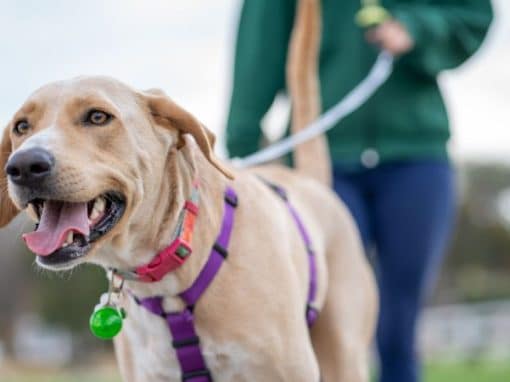
A flat collar is adequate for a dog that already walks calmly on a loose lead. For any dog that pulls, lunges or has a narrow or collapsing trachea, a well-fitted harness is the safer choice, because it spreads load across the chest instead of concentrating it on the throat. Small breeds in particular benefit, as tracheal problems are common among them.
Lead Length
A fixed lead of roughly 1.5 to 2 metres gives a dog room to move naturally while leaving you in control. Retractable leads work against loose lead training, because the dog is rewarded with more distance every time it pulls, and they offer poor control in traffic or when another dog approaches.
Teaching a Loose Lead
Pulling persists because it works. The dog pulls, the walk continues, and the behaviour is reinforced several hundred times a week. Breaking that cycle means making pulling stop producing progress: the moment the lead goes tight, you stop; the moment it slackens, you move off again. Progress is slow at first and then quite sudden, provided every person who walks the dog applies the same rule.
Start this work somewhere quiet rather than on a busy pavement, and build up. Our guide to leash training for dogs sets out the full progression, and for young dogs it pairs naturally with structured socialisation during the sensitive period.
Walking Safely in the South African Climate
Tar and paving absorb far more heat than air temperature suggests, and they stay hot well after the peak of the day. Press the back of your hand to the surface and hold it there for seven seconds. If you cannot keep it there comfortably, it is too hot for paws. On warm Cape Town days that usually rules out the middle of the day entirely and pushes walks to early morning and evening.
Carry water on anything longer than a short loop, watch for early heat stress such as heavy panting, thick drool or a dog that starts lagging, and remember that dark-coated and flat-faced dogs overheat faster. Tick exposure is worth planning for too if you walk on the mountain or through long grass.
Handling Common Problems on the Lead
Reacting to Other Dogs
Barking and lunging at other dogs is usually distance-seeking behaviour rather than aggression. The dog is uncomfortable and is trying to make the other dog go away. Punishing the display suppresses the warning without changing the discomfort, which is the opposite of what you want. Increase distance until your dog can notice another dog without reacting, reward calm attention at that distance, and close the gap gradually over weeks.
Jumping at People
Greetings on a walk are where jumping is most often rehearsed, because strangers reward it with attention. The fix is consistency from the handler rather than the stranger, and our guide on stopping a dog jumping on people covers the practical steps.
Know the Local Rules
Leash requirements are set by municipal by-law and vary between metros and even between specific beaches, parks and nature reserves within one city. Check the signage at any new spot rather than assuming, and note that off-lead access is generally conditional on reliable recall. Welfare organisations such as the Cape of Good Hope SPCA publish guidance on responsible ownership, and the broader practice is summarised on Wikipedia.
When to Get Help
If your dog's behaviour on the lead has become dangerous to handle, has changed suddenly, or has not improved after a few consistent weeks, get it assessed rather than repeating the same approach. Sudden reluctance to walk or a change in gait warrants a veterinary examination first, since pain is a common and easily missed driver. Where the cause is behavioural, a qualified behaviour consultation will identify what is maintaining the problem and set out a plan that fits your dog.