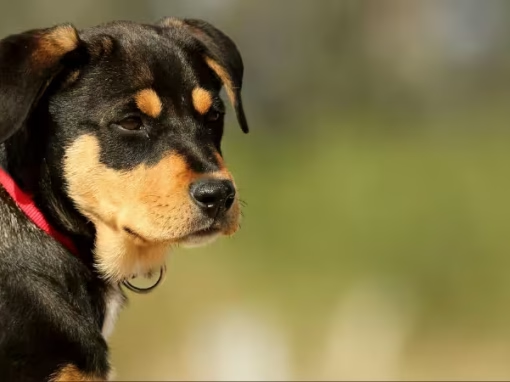
The domestication of dogs is the oldest known partnership between humans and another species — and arguably the most consequential. Long before we domesticated cattle, horses, or cats, wolves began living alongside human hunter-gatherers. That relationship, which started somewhere between 15,000 and 40,000 years ago, fundamentally changed the trajectory of both species.
When Were Dogs First Domesticated?
The exact timeline remains debated, but the scientific consensus narrows it to between 15,000 and 40,000 years ago — deep in the last Ice Age. The earliest undisputed dog remains come from a 14,200-year-old burial site in Bonn-Oberkassel, Germany, where a puppy was found carefully buried alongside two humans. Older contested finds from Siberia and Belgium push potential dates back to 33,000–36,000 years ago.
DNA analysis has complicated the picture rather than simplifying it. A 2016 study published in Science suggested dogs may have been domesticated independently in both Europe and East Asia from different wolf populations, with the Eastern lineage eventually replacing or merging with the Western one. More recent research leans toward a single domestication event in Central Asia or the Middle East, with subsequent diversification as dogs migrated with human populations.
How Did Wolves Become Dogs?
The most widely accepted theory is self-domestication — the idea that wolves domesticated themselves by scavenging near human camps.
The Scavenger Hypothesis
As humans settled into semi-permanent camps, waste piles accumulated. Wolves that were less fearful of humans could exploit this food source. Over generations, the boldest, most human-tolerant wolves gained a survival advantage. Natural selection favoured traits that made them better camp followers: smaller body size, reduced aggression, shorter muzzles, and — crucially — the ability to read human social cues.
The Partnership Hypothesis
An alternative theory suggests active cooperation. Early humans and wolves were both pack-based, social hunters targeting the same large prey. Wolves could track and pursue game across distances; humans could deliver the killing blow with weapons. A mutually beneficial hunting partnership may have driven the initial association, with domestication following naturally.
The Domestication Syndrome
Regardless of the initial mechanism, domestication triggered a cascade of physical and behavioural changes known as domestication syndrome. As wolves became dogs, they developed:
- Floppy ears (reduced cartilage related to lower adrenaline production)
- Curled tails
- Shorter snouts and smaller teeth
- Coat colour variation (spots, patches, and colours not seen in wild wolves)
- Reduced brain size (approximately 20% smaller than equivalent-sized wolves)
- Extended sociality — dogs retain juvenile wolf behaviours (playfulness, dependence) into adulthood
These changes weren’t bred intentionally — they emerged as byproducts of selecting for tameness. Russian geneticist Dmitri Belyaev demonstrated this dramatically in his famous fox domestication experiment, where selectively breeding silver foxes for friendliness produced floppy ears, curled tails, and spotted coats within just a few generations.
How Dogs Changed Human History
The domestication of dogs didn’t just give us pets. It reshaped human civilisation in ways that are easy to underestimate.
Hunting
Dogs dramatically improved human hunting efficiency. They could track wounded game, flush prey from cover, and hold large animals at bay. Archaeological evidence suggests that human hunting success rates increased significantly after dogs entered the picture. Some researchers argue that dogs gave modern humans a competitive advantage over Neanderthals, who did not appear to use dogs.
Herding and Agriculture
As humans transitioned from hunting to farming roughly 10,000 years ago, dogs adapted alongside them. Herding breeds — ancestors of today’s collies, shepherds, and sheepdogs — became essential for managing livestock. Without dogs, large-scale animal husbandry may have been impractical. The intelligence of dogs played a key role in this transition.
Protection
Guard dogs protected early human settlements from predators and rival groups. In South Africa, the Boerboel was developed specifically for this purpose — protecting farms from leopards, baboons, and intruders in a landscape where fencing wasn’t an option. The Africanis served similar roles in indigenous communities.
Companionship and Social Bonding
Perhaps most significantly, dogs became the first species to form emotional bonds with humans outside of kinship. Ancient burial sites across the globe show dogs interred with their owners — sometimes with grave goods — suggesting these animals were valued as more than tools. The human-dog bond may have primed our species for future domestication relationships with horses, cattle, and cats.
The Genetic Legacy
Modern dog breeds are a remarkably recent development. For most of the 15,000+ years of dog domestication, dogs were generalised village dogs — similar in type to today’s Africanis or Asian pariah dogs. The explosion of breed diversity only began around 200 years ago during the Victorian era, when kennel clubs formalised breeding standards.
This means the roughly 400 recognised dog breeds worldwide represent less than 2% of the total timeline of dog domestication. The vast majority of genetic variation in domestic dogs predates breed formation — which is why mixed-breed dogs and landrace types often enjoy better health than their purebred counterparts.
Dogs and Humans Today
The domestication process hasn’t stopped. Dogs continue to evolve alongside us — developing skills like reading human pointing gestures, following our eye gaze, and responding to emotional cues in ways that no other species matches, including our closest primate relatives.
Research published in Current Biology found that dogs have evolved a specific muscle above their eyes (the levator anguli oculi medialis) that wolves lack. This muscle produces the “puppy dog eyes” expression that triggers a nurturing response in humans. It’s a trait that appears to have evolved specifically through thousands of years of human selection — we favoured dogs that could communicate with us through facial expression.
Understanding the psychology of how dogs think — shaped by millennia of co-evolution with humans — is the foundation of effective positive reinforcement training. When you train a dog, you’re working with a mind that has been optimised by natural selection to cooperate with yours.