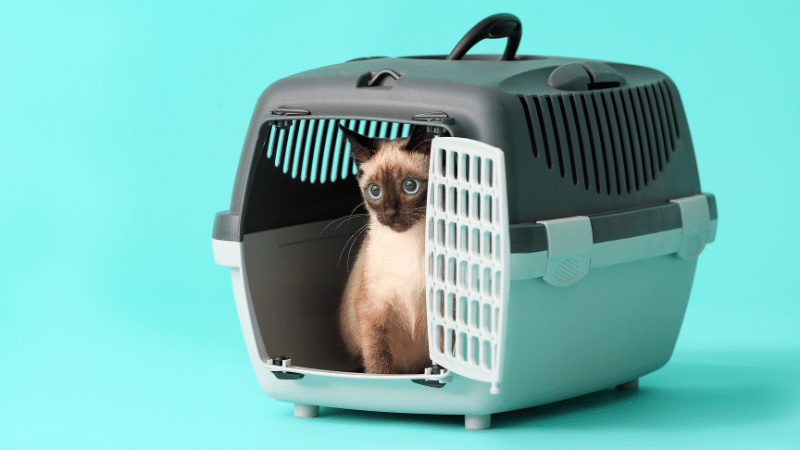
For most cats, a carrier is not luggage. It is a box that appears twice a year, immediately before something unpleasant happens. That association is learned fast and held stubbornly, which is why a relaxed cat becomes a growling, flattened, immovable object the moment the carrier comes out.
Carrier stress is a training problem, not a personality flaw. With the right equipment and a few weeks of low-pressure conditioning, most cats will load calmly and travel quietly.
Choosing a Cat Carrier That Actually Works
Go hard-sided with a removable top
The single most useful feature in a travel cat carrier is a top half that unclips from the base. It lets you lift the lid off rather than tipping your cat out or dragging her through a small front door. Anxious cats can often stay in the base for the whole consultation, which removes the worst part of the visit entirely, and most practices will work this way if you ask.
Size it for security, not space
Cats settle better in a snug, den-like space. Your cat should be able to stand, turn around and lie flat, and no more. An oversized carrier lets her slide about under braking.
What to avoid
Skip soft fabric bags with mesh panels for anything beyond short journeys: they collapse, they are hard to clean after an accident, and a determined cat can claw through the mesh. Cardboard carriers are for emergencies only.
Carrier Familiarisation: A Two-Week Approach
You cannot condition a cat to a carrier on the morning of the appointment. Start at least a fortnight out.
Week one: the carrier becomes furniture
Take the door off, or clip it open. Put the carrier in a room your cat already uses, with a familiar-smelling blanket inside. Feed treats near it, then inside it. Do not lure her in, shut the door and declare victory. The point is that the carrier stops being an event and becomes background furniture.
If your cat is already reactive around handling, build a foundation first with basic cat training before you introduce the carrier at all.
Week two: adding the door and short trips
Once your cat enters freely, start closing the door for a few seconds, then opening it before she asks. Build up to a minute, then two. Next, lift the carrier with her inside, walk to another room and set it down. Then walk to the car. Then sit in the car with the engine running and go nowhere.
Each step should be boring. If your cat vocalises, freezes or refuses food, you have moved too fast — drop back a stage and stay there for a few more sessions.
Loading Your Cat Without a Fight
On the day, shut the doors and windows of one room and bring the cat and the carrier into it. Chasing a cat through a house before a vet visit undoes weeks of work.
If she will not walk in, remove the top half of the carrier, lower her into the base rear-end first with one hand supporting the chest and the other the hindquarters, then refit the lid. Rear-end first matters: cats brace against a forward entry with their front legs, and a head-first push almost always ends in a scramble.
Never scruff a stressed cat. It escalates arousal and damages the trust you need for the next trip. If your cat is genuinely aggressive when handled, our guidance on dealing with an aggressive cat covers where to start.
Securing the Carrier in the Vehicle
A cat carrier on a seat is an unrestrained object. In a collision it becomes a projectile, and in ordinary heavy braking it slides and tips.
The safest position is on the floor behind the front passenger seat, wedged so it cannot move. If you must use a seat, run the seatbelt through the carrier’s handle or strap slots and pull it tight. Drape a light cloth over three sides — cutting visual input reduces motion stress, while leaving one side open maintains airflow.
Cats should never travel loose in a car: dangerous for the cat, a real distraction risk for the driver. For longer journeys, our guide to car travel with cats covers route planning, comfort breaks and what to pack.
Heat: The Risk South African Owners Underestimate
A parked car in a South African summer reaches lethal temperatures within minutes, and a cat inside a carrier cannot move to shade or cooler air. Never leave her in a stationary vehicle — not for a quick shop, not with the windows cracked, not in the shade.
On hot days, run the air conditioning before you load her, and check the carrier is not sitting in direct sun through a window. The NSPCA treats animals left in hot vehicles as a welfare offence, and with good reason.
Arrival and the Journey Home
At the practice, keep the carrier off the floor and away from dogs, cloth still over it.
The trip home is where owners relax too early. Your cat now smells of the clinic, which in multi-cat households can trigger non-recognition aggression from housemates. Let her leave the carrier in her own time in a quiet room, and give the household a few hours before free mixing — a predictable, enriched environment speeds this up, which is an underrated benefit of proper enrichment for indoor cats.
When to Involve Your Vet
Some cats do not respond to conditioning alone. If your cat hypersalivates, vomits or soils the carrier on every journey, speak to your vet about anti-nausea medication or short-acting anxiolytics used alongside the training. This is not a shortcut — it makes the behavioural work possible in cats whose stress response is too high to learn through. Preventative and travel-health guidance from the American Veterinary Medical Association is a useful starting point.
Get the carrier right and it stops being a trigger. That single change makes vet visits, relocations and emergencies far easier for the rest of your cat’s life.