Cat whiskers are routinely described as decorative, or as something that helps a cat “keep its balance”. Both undersell them and the second is not quite right. Whiskers are precision touch organs, and once you understand what they measure, several everyday cat behaviours stop looking mysterious.
What Cat Whiskers Actually Are
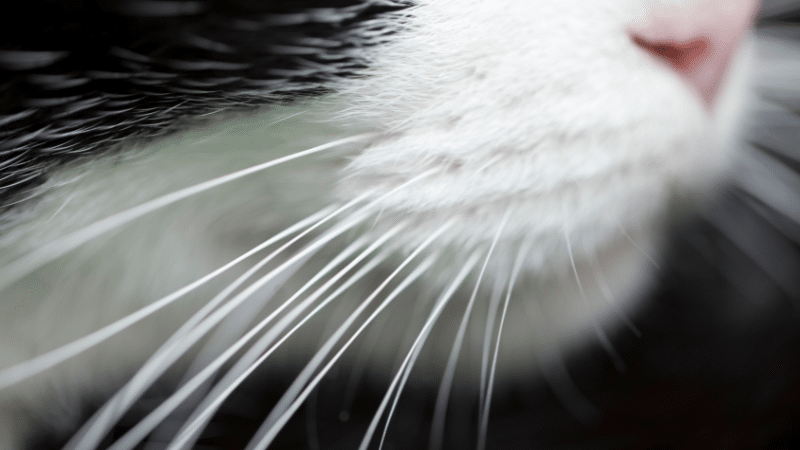
Whiskers, properly called vibrissae, are not ordinary hairs. They are thicker, stiffer and rooted roughly three times deeper than a coat hair, in a follicle wrapped in blood vessels and packed with nerve endings. The shaft itself is dead tissue with no feeling in it. It works as a lever: air movement or contact at the tip deflects the shaft, and the follicle at the base converts that deflection into a nerve signal.
That is why a cat can register something it has not touched. A whisker responds to displaced air, so your cat can detect the presence and rough shape of an object in complete darkness before making contact.
How Many Whiskers Does a Cat Have?
Most cats carry around 24 on the muzzle, in four rows on each side. The top two rows move independently of the bottom two, which lets a cat sweep the upper field while holding the lower field steady.
The muzzle is not the whole set. There are vibrissae above the eyes, on the chin, and, less obviously, on the back of the front legs. Those carpal whiskers matter more than their size suggests, and they come up again below.
Balance, or Spatial Awareness?
Here is the correction worth making. Balance in cats is vestibular, handled by the inner ear, which also drives the righting reflex when a cat falls. Whiskers do not perform that function.
What whiskers provide is spatial awareness, a continuously updated map of what is immediately around the head and forelimbs. The two systems work together, so the distinction can look academic, but it is not. A cat with damaged whiskers does not fall over. It misjudges gaps, bumps into things in the dark and becomes hesitant. That is a navigation deficit, not a balance one.
Judging Gaps
The muzzle whiskers extend to roughly the width of the cat’s body, giving an on-board measure of whether an opening is passable. It is a guide rather than a precise instrument, and it reflects a body shape the cat may no longer have. This is why overweight indoor cats get stuck in places a lean cat of the same frame would clear.
Navigating in the Dark
Cats see far better than we do in low light, but not in true darkness. When light drops below the level their eyes can work with, whiskers take over the close-range job. It is a genuine sensory handover, and it pairs with the differences covered in our comparison of cat vision and human vision. The same system explains much of the confident movement described in why cats are most active at night.
Whiskers as a Hunting Tool
This is where the carpal whiskers earn their place. A cat’s eyes cannot focus well within roughly 30 centimetres, which is precisely the distance at which prey is held. At the moment of the final bite the cat effectively cannot see what it is holding.
The muzzle whiskers fan forward around the prey and the carpal whiskers on the forelegs report on the animal held between the paws. Together they tell the cat which way the prey is oriented and where the neck is, so the killing bite can be placed accurately without vision. Watch a cat with a toy and you will see the whiskers sweep forward at the moment of capture.
Reading Your Cat’s Mood From Its Whiskers
Whisker position is one of the more reliable mood indicators on a cat, and easier to read than tail position because there is less ambiguity in it. Relaxed whiskers sit out to the side, loosely fanned. Forward and fanned means alert, interested or hunting. Flattened back against the cheeks means fear or defensiveness, and it usually appears well before a swipe. If you are working through biting or over-arousal during handling, whisker position will often warn you a few seconds before the paws do.
Do Cat Whiskers Grow Back?
Yes. Whiskers are shed and replaced naturally throughout a cat’s life, usually one or two at a time, so finding one on the floor is not a concern. A whisker lost or broken through injury will regrow, though it takes several weeks to months to reach full length.
What matters is the interval. Until it regrows the cat is navigating with an incomplete map, and a cat that has lost several at once is often visibly more cautious at night. If whiskers are falling out in numbers, or the skin around the follicles is inflamed or scabbed, that is a veterinary matter rather than a grooming one.
Whisker Fatigue: What It Is and What It Is Not
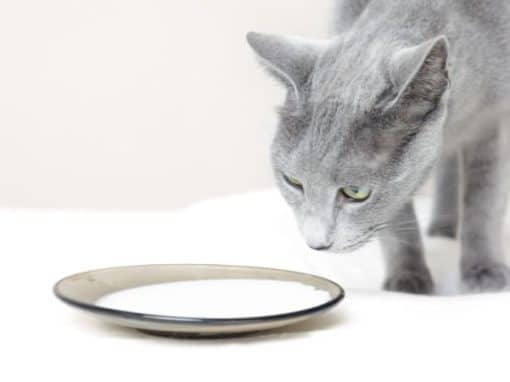
Whisker fatigue describes the discomfort of whiskers repeatedly brushing the sides of a deep, narrow bowl. It is a plausible mechanism given how sensitive the follicles are, and the fix costs nothing: use a wide, shallow dish so the whiskers clear the rim.
Be careful with the claim, though. It is a reasonable inference rather than an established diagnosis, and it is worth ruling out dental pain, nausea and simple food preference before concluding that a cat leaving food at the edges of a bowl has a whisker problem. Cats also go off food for reasons of stress and environment, which is why proper enrichment for indoor cats often resolves feeding oddities that a new bowl does not.
What You Should Never Do
Never trim or pluck a cat’s whiskers. There is no grooming reason to do it and no aesthetic justification that outweighs the cost. A trimmed cat is disoriented, less accurate in the dark and, in multi-cat homes, measurably less confident. If a groomer suggests it, decline.
Carry the broader point into everything else you do with your cat. Handling, play and training all go better when you work with the sensory equipment rather than against it, which is the principle underlying our beginner’s guide to cat training. For the anatomy behind all of this, the overview of vibrissae across mammals is a solid reference.