A cat purring is one of the most familiar sounds in any home, and one of the most widely misread. Most owners treat it as a simple contentment signal — cat purrs, cat is happy, job done. The reality is more interesting. Purring is a low-frequency vibration cats produce in situations ranging from deep relaxation to acute pain, and reading it in context tells you far more than the sound alone ever will.
How a Cat Purring Actually Works
Purring sits apart from almost every other sound a cat makes. A meow, a hiss or a yowl happens on the outbreath. A purr continues through both inhalation and exhalation, producing that near-unbroken rumble, and it does so at a remarkably low fundamental frequency — roughly 20 to 30 Hz, far lower than you would expect from an animal that size.
The mechanism sits in the larynx. Rapid cycling of the laryngeal muscles narrows and opens the glottis, and airflow through that shifting gap generates the vibration. Research published in 2023 added a wrinkle: pads of connective tissue within the vocal folds appear to let cats hit these very low frequencies without continuous neural input driving every cycle. The debate over how much of a purr is actively driven and how much is passive aerodynamics is genuinely unresolved, which is unusual for a sound this common.
There is also a rough split across the cat family: cats that purr continuously generally do not roar, and the roaring cats do not purr in the sustained way a domestic cat does. That divide traces back to the structure of the hyoid apparatus supporting the larynx. The Wikipedia entry on purring covers the comparative anatomy.
What Cat Purring Means — It Is Not Always Contentment
Contentment and social bonding
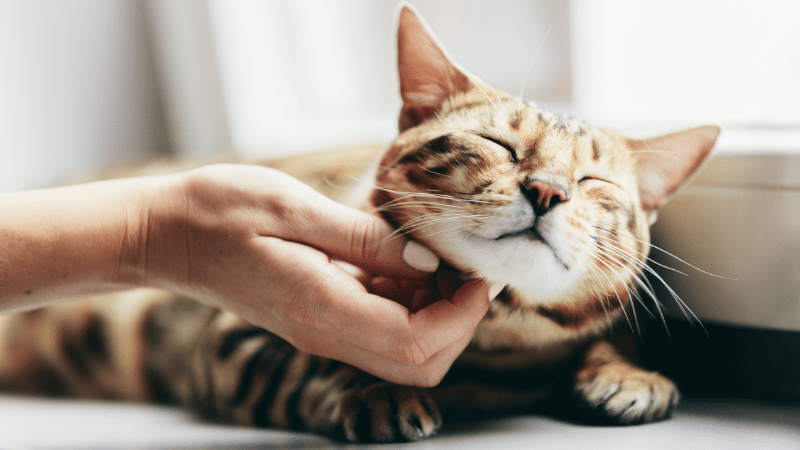
This is the most common context, and it is real. A cat purring while settled on your lap, eyes half-closed and body loose, is telling you it is comfortable and socially at ease. Kittens purr from a few days old while nursing, and queens purr back — a close-range “all is well” signal at an age when kittens cannot yet see or hear properly.
Stress, pain and self-soothing
Cats also purr when frightened, injured, in labour, at the vet, and sometimes while dying. That is not a contradiction. The workable interpretation is that purring is a self-soothing and appeasement behaviour as much as a contentment one. A cat purring on the consult table is not enjoying itself — it is managing stress.
The solicitation purr
Cats living with humans develop a variant in which a high-frequency cry of roughly 380 to 560 Hz is embedded inside the normal low rumble. That frequency sits close to the range of an infant cry, and people consistently rate it as more urgent and harder to ignore than an ordinary purr. If your cat has a specific “feed me” purr that gets under your skin in a way its evening lap purr does not, that is what you are hearing — a learned behaviour aimed squarely at you. The same principle runs through feline vocal communication generally, which we cover in our guide to why cats meow and what different sounds mean.
Cat Purring and Healing: What the Evidence Actually Supports
The claim that purring heals the cat doing it has been repeated so often it is treated as established. It is not. The reasoning runs like this: low-frequency mechanical vibration in the 25 to 50 Hz band has been associated with bone density maintenance and soft-tissue repair in other research contexts, and cat purring falls in that band. Therefore purring may be a self-repair mechanism that also explains why cats purr when injured.
That is a plausible hypothesis, not a demonstrated finding — nobody has shown that a cat purring measurably speeds its own healing. Treat it as an open question, and never as a reason to delay veterinary care. A purring cat can still be seriously unwell.
The Effect of Cat Purring on Humans
The effect running in the other direction is better supported. Sitting with a purring cat is a low-demand, repetitive, tactile activity, and that combination reliably reduces subjective stress for most people — though the specific contribution of the purr is hard to isolate from simply having a cat on your lap. We cover this in our piece on the mental health benefits of pets.
Reading Your Cat’s Purr in Context
The purr on its own is ambiguous. The body around it is not. Read them together:
- Relaxed purring — loose posture, slow blinking, ears forward or neutral, tail still or gently moving. Often paired with kneading, which shares the same nursing-behaviour origin.
- Stressed purring — crouched or tucked body, ears flattened or rotated back, pupils dilated, whiskers pulled tight against the face, tail wrapped in.
- Solicitation purring — cat is oriented at you, mobile, usually near a food bowl or a door, purr has that insistent edge to it.
Sudden changes matter more than any single reading. A cat that has always purred readily and stops, or one that starts purring in situations where it previously did not, is worth paying attention to. Building that baseline is really just a matter of knowing your own animal, which is the foundation of understanding cat behaviour generally.
When Purring Should Send You to the Vet
Book an appointment if purring appears alongside hiding, appetite loss, laboured or open-mouthed breathing, reluctance to be touched in a particular spot, litter box changes, or a hunched, guarded posture. Purring accompanied by any of these is a cat coping, not a cat content. If you are unsure whether a behavioural change warrants a consult, err towards booking it — and if you encounter an animal in distress or suspect neglect, the NSPCA is the appropriate body to contact in South Africa.
Purring is not a diagnosis. It is one signal among several, and it only becomes useful once you read it against the rest of what your cat is doing.