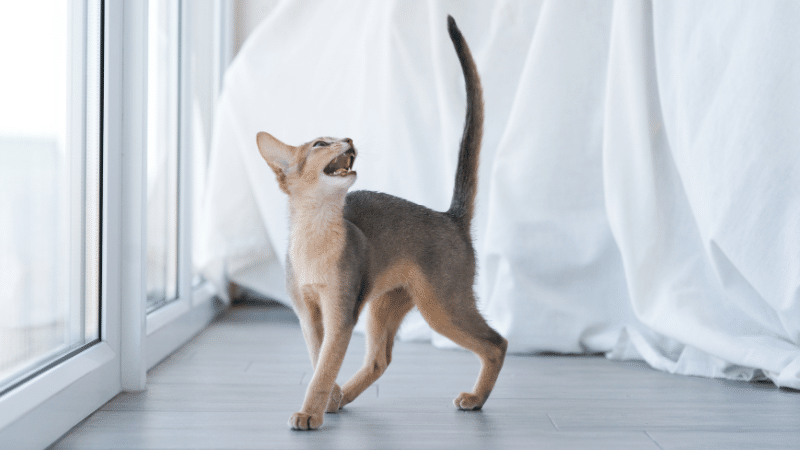
Ask why do cats meow and the honest answer is short: because it works on you. Meowing is not a general-purpose cat language. It is a channel that domestic cats developed and refined specifically for communicating with humans, and understanding that changes how you respond to it.
Cats Do Not Really Meow at Each Other
Kittens meow to their mother. It is a distress and location call — cold, hungry, separated — and the queen responds to it. Once cats reach social maturity, that call largely drops out of cat-to-cat communication. Adult cats interacting with other adult cats rely mainly on scent marking, body posture, tail position and ear orientation, plus a set of close-range sounds like growls, hisses and yowls that are almost entirely about conflict or mating.
What adult cats do not generally do is meow at each other conversationally. They meow at us. The behaviour was retained and redirected, and it persists because humans are poor at reading scent marks and tail positions but respond immediately to sound. Over roughly ten thousand years of living alongside people, that gave vocal cats an advantage. The overview of cat communication on Wikipedia sets out the full signalling repertoire if you want the wider picture.
What Different Cat Meow Sounds Mean
There is no universal dictionary here — individual cats develop idiosyncratic signals with their own households — but the broad categories hold up well.
Short, high-pitched meow
A greeting. Typically delivered when you walk in, often with the tail held upright. Low-stakes and social.
Drawn-out, insistent meow
A demand. Food, a closed door, an empty water bowl. This is the sound most likely to carry the embedded high-frequency urgency that makes it genuinely difficult to ignore — the same mechanism at work in the solicitation purr described in our article on the science behind cats purring.
Chirps and trills
A rolling, mid-pitched sound made with the mouth closed. Queens use it to direct kittens, and cats commonly redirect it at owners as a “follow me” — usually towards a food bowl. It is a friendly, non-urgent signal.
Yowls and low moans
Longer, lower and more variable. Yowling covers territorial disputes, mating calls in unspayed females, disorientation in older cats, and pain. This is the cat meow sound that most warrants attention rather than a response.
Chattering
The rapid jaw stutter aimed at birds through a window. Not directed at you at all — most readings treat it as frustrated predatory arousal.
Why Do Cats Meow So Much?
Excessive meowing has three common explanations, and they need separating before you try to fix anything.
You have accidentally trained it
This is the most frequent cause. If meowing sometimes produces food, attention or a door being opened, you have created an intermittent reinforcement schedule — the single most durable way to strengthen a behaviour. Caving on the tenth meow after ignoring nine teaches your cat that ten meows is the price. The same trap catches owners dealing with a cat that begs for food.
Medical causes
A genuine increase in vocalisation, particularly in a cat over about seven, is a veterinary matter until proven otherwise. Hyperthyroidism, high blood pressure, chronic kidney disease and pain all drive increased vocalisation. So does deafness — a cat that cannot hear itself tends to get louder. Rule these out before treating it as behavioural.
Age-related cognitive decline
Senior cats can develop cognitive dysfunction, and one of its hallmarks is loud, apparently purposeless vocalising, often at night and often in an empty room. It is distressing to listen to and frequently misread as attention-seeking.
Why Do Cats Meow at Night?
Cats are crepuscular — naturally most active around dawn and dusk — so a cat that is under-stimulated all day will surface with energy at exactly the hours you want to sleep. Night vocalising usually comes down to boredom, hunger, or the cognitive changes above. The behavioural fix is almost never to respond in the moment; it is to shift the cat’s activity budget earlier with a substantial interactive play session in the evening, followed by a meal. Our guides to why cats are active at night and training a cat to sleep through the night cover the protocol properly.
Should You Respond to Meowing?
Selectively. Ignoring every meow is neither realistic nor desirable — meowing is a legitimate communication channel and some of it carries real information. The rule that works is to respond to the cat, not to the noise.
In practice: wait for a pause in the vocalising and respond then, so the quiet gets reinforced rather than the volume. Keep feeding on a fixed schedule so meowing has no bearing on when food appears. Never respond intermittently to a demand you have decided not to meet — that is worse than always giving in, because it teaches persistence. And make sure the underlying need is actually covered; a cat with enough to do meows less, which is why enrichment for indoor cats does more for excessive vocalisation than any direct intervention.
Do Feral Cats Meow?
Rarely, and this is the clearest evidence for the whole argument. Feral cats — unsocialised to people — are notably quiet around humans. They hiss, growl and yowl, but the conversational meow directed at a person is largely absent. Meowing at humans is a learned, socialised behaviour, not an automatic feline one.
Reading Meowing in Context
Volume, frequency and change matter more than any individual sound. A chatty Siamese meowing constantly is unremarkable; a normally quiet cat that becomes vocal over a fortnight is a red flag. Track the pattern, rule out medical causes first, then look honestly at what the household has been reinforcing. If a behavioural change appears alongside weight loss, appetite change, litter box problems or hiding, book a veterinary consult — the South African Veterinary Association can help you find a practice near you.