A dog door is one of the few household modifications that improves life for the dog and the owner at the same time. Your dog stops depending on you for every toilet break and garden run. You stop being a doorman. Done properly, the installation takes an afternoon and pays for itself in reduced indoor accidents and calmer behaviour.
Done badly, it becomes a security weak point, a draught, or a hole in the wall your dog refuses to walk through. This guide covers the practical decisions in the order you need to make them.
What a Dog Door Actually Changes
Dogs left indoors without garden access hold their bladder for as long as they physically can. For an adult dog that is six to eight hours; for a puppy or a senior dog it is far less. Beyond the discomfort, prolonged holding is linked to urinary tract problems, and the resulting anxiety frequently surfaces as chewing, digging or barking at nothing.
Free access removes the pressure. Dogs with a dog door self-regulate their activity through the day, choose sun or shade as they like, and typically show less separation-related distress. If your dog already barks or destroys things when left alone, a dog door treats one contributing cause, though not the underlying anxiety. Our article on positive reinforcement dog training covers the behavioural work that goes alongside it.
Types of Dog Door
Traditional flap doors
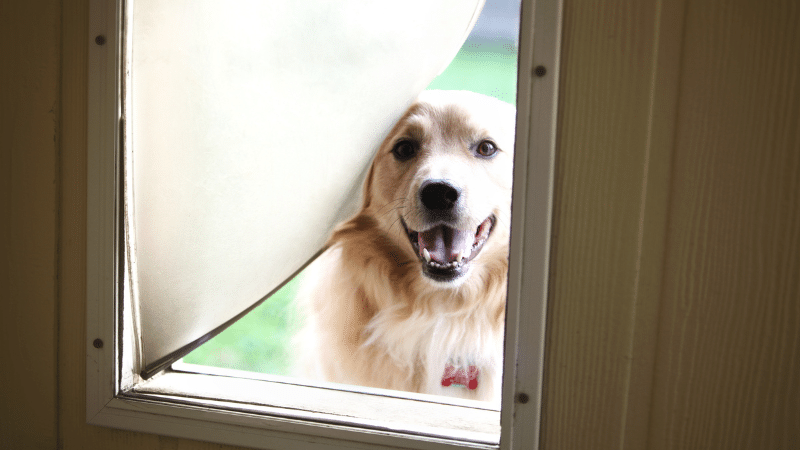
A hinged or floppy vinyl flap in a frame, fitted into a wooden or composite door. Cheapest and simplest. Look for a double-flap design with magnetic closers if you want any meaningful insulation, and a brush seal if you live somewhere dusty. Single thin flaps let in wind, rain and insects.
Electronic and microchip dog doors
These unlock only for a collar tag or your dog’s implanted microchip. Worth the extra cost if you have a problem with neighbourhood cats, monkeys in KwaZulu-Natal and Mpumalanga, or if you want to lock the door on a schedule so the dog stays in overnight. They need batteries or mains power, so check what happens during load shedding: better units fail locked, cheaper ones fail open.
Dog door for a sliding glass door
The most common South African setup, since so many homes open onto a patio through sliding doors. A dog door for a sliding glass door is fitted as a full-height insert panel that sits in the existing track, so you cut nothing and drill nothing. This makes it the only realistic option for tenants. The trade-off is that the panel narrows the doorway by roughly the width of the insert, and cheaper panels compromise the door’s locking alignment. Measure the track height accurately before ordering, because most panels are adjustable only within a few centimetres.
Wall-mounted units
Fitted through a brick or plaster wall with a tunnel section. Most secure and best insulated, and the right choice for security doors or where no suitable door exists. Not reversible, so be sure of the position.
Sizing It Correctly
Measure your dog’s shoulder height from the floor, and the widest point of their body, usually the chest or hips. The flap opening should be at least 5cm taller than shoulder height and 5cm wider than the widest point.
The step-over height, meaning the distance from the floor to the bottom of the flap, matters just as much and is where most people go wrong. Set it no higher than one third of your dog’s shoulder height. Too high and older dogs or dogs with hip problems will stop using it. If you have a growing puppy, size for the adult dog and expect to help them through initially. Breed matters here too: a Labrador and a Boerboel have very different chest widths at similar heights.
Training Your Dog to Use It
Most dogs take a few days, some take weeks. The sequence that works:
Prop the flap fully open and tape it up so there is a clear hole. Let your dog walk through with no resistance for a day or two, rewarding every pass.
Call them through from the other side using a treat they actually care about. Never push them through the opening, because one bad experience with the flap slapping their back can set you back weeks.
Lower the flap in stages, taping it half open first so it brushes them lightly, then releasing it fully. Keep rewarding.
Practise in both directions. Dogs frequently learn to go out but not come back in, because the light and the view differ from each side.
If your dog is generally hesitant about novelty, address that first. The gradual exposure method in our guide to socialising your puppy applies directly, and the reward timing in clicker training is useful for marking the exact moment they commit to stepping through.
Security and Practical Considerations
A dog door is a hole in your perimeter, and in South Africa that deserves honest thought rather than dismissal. Keep the opening small enough that a person cannot fit through, which realistically means anything above roughly 30cm by 40cm needs mitigation. Never fit a dog door where someone reaching through can access a key, a handle or a window latch. Fit the door on a side that is inside a walled or fenced yard rather than opening onto a public boundary, and use the supplied locking cover panel at night.
Electronic doors solve most of this, since they stay locked without an authorised chip nearby. Add a beam or alarm zone on that opening if your yard is not already covered.
Also check the outdoor side is safe and shaded, and that your dog cannot get out of the property itself. A dog with free garden access needs an escape-proof fence and up-to-date identification. Our guide to dog vaccinations is worth reviewing if your dog is now spending significantly more time outdoors.
For general welfare guidance on outdoor access and shelter requirements, see the NSPCA. Technical background on the various designs is covered in the pet door overview.