Most cat toys fail for the same reason: they are designed to appeal to the person buying them. Cats do not care about clever features or fabric prints. They care about whether an object behaves like prey, and whether playing with it lets them finish the sequence their brain is built to run.
Get that right and a R40 wand toy will outperform an expensive electronic gadget every time.
What Cats Actually Want From Play
Cats are obligate predators, and play is a rehearsal of the hunting sequence: stalk, chase, pounce, grab, bite. Domestic cats retain the full sequence even when they have never needed to hunt for food. A toy that supports only one stage of it — usually the chase — leaves the cat aroused and unsatisfied.
That is the practical test for any cat toy. Can your cat stalk it, chase it, catch it and hold it? If not, the toy is incomplete.
It also explains why play matters behaviourally. Unspent predatory drive gets redirected — onto ankles, onto other cats, or into 3am zoomies. A large share of the biting and night-activity complaints we see trace back to a cat with no legitimate outlet.
The Categories of Cat Toys That Earn Their Place
Wand and rod toys
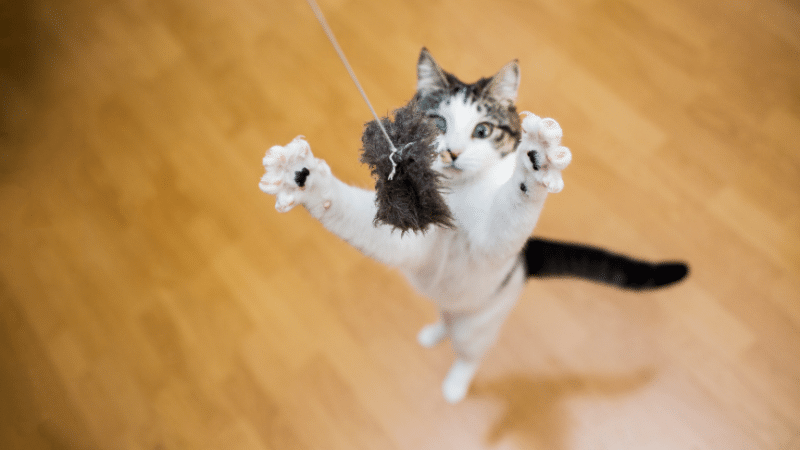
The most valuable item in the box. A wand lets you control the prey, which means you can make it behave correctly: moving away from the cat rather than towards her, hiding behind furniture, pausing, twitching. Cats do not chase things that charge at them.
Critically, wand play lets you script a proper ending. Let her catch it, hold it and rabbit-kick it for a few seconds, then feed a small treat or a meal. That sequence — hunt, catch, eat — is what actually settles a cat. Store wands out of reach between sessions: loose string and elastic are a hazard if chewed unsupervised.
Solo and self-play toys
Small, lightweight, throwable objects: crinkle balls, spring coils, fabric mice. Cats bat these under furniture and hunt them back out, which is the point. Rotate a handful in and out weekly rather than leaving twenty on the floor — novelty is most of the value.
Puzzle and food-dispensing toys
Feeding toys make the cat work for calories, which slows eating, adds mental load and is one of the more effective interventions for overweight indoor cats. Start easy: a puzzle that is too difficult on day one gets abandoned and never revisited. These belong in a broader plan, and our guide to enrichment for indoor cats covers how they fit alongside vertical space and window access.
Interactive and electronic toys
An interactive cat toy that moves on its own can work for cats left alone during the day, but treat it as a supplement. It does not replace fifteen minutes of wand play.
Catnip and silvervine
Roughly a third of cats do not respond to catnip at all, and the trait is inherited. Silvervine and valerian are worth trying in non-responders. Catnip is a mood modifier rather than a toy, and the effect is best preserved by occasional rather than daily use.
What to Avoid
Laser pointers are the most common mistake. The cat completes the hunting sequence right up to the catch, and then there is nothing there. Repeated over weeks this produces real frustration and, in some cats, obsessive light-chasing. If you use one, finish by landing the dot on a physical toy or scattered treats.
Also avoid:
- Loose string, wool, tinsel and ribbon. Swallowed thread is a linear foreign body — it can concertina the intestine and requires emergency surgery. This is a routine cause of theatre time in small animal practice, not a freak accident.
- Toys with glued-on eyes, bells or small plastic parts that come off under chewing.
- Anything smaller than your cat’s mouth that is not attached to something.
- Your hands. Playing rough with bare hands teaches a kitten that skin is a legitimate target, and it is far harder to untrain later — the reasoning is set out in how to stop your cat from biting.
Matching Toys to the Cat in Front of You
Watch how your cat hunts and buy accordingly. Ground-hunters that stalk low along skirting boards respond to toys dragged along the floor and to mouse-shaped objects. Air-hunters that leap at moths want feather wands moved above head height.
Age changes the picture. Kittens play with almost anything and need frequent short bursts. Cats over ten often still want to hunt but tire faster and may have arthritic joints, so keep the prey lower and the sessions shorter. Breed matters too: high-energy breeds such as Bengals need substantially more structured play than a placid domestic shorthair.
Building a Play Routine That Changes Behaviour
Frequency beats duration. Two or three sessions of ten to fifteen minutes will do far more than one long session at the weekend.
Timing is the lever most owners miss. Cats are crepuscular, most active around dawn and dusk. A structured wand session in the early evening, followed immediately by the main meal, works with that rhythm instead of against it — and it is the most reliable fix for a cat waking the household before sunrise. Our explanation of why cats are active at night covers the underlying pattern.
When to Replace a Toy
Inspect toys monthly. Bin anything with exposed stuffing, frayed cord, loose bells or chewed-through seams. Wash fabric toys, and refresh catnip toys every few months as the volatile oils fade.
If your cat has lost interest in everything at once, that is not boredom. A sudden drop in play behaviour can be an early sign of pain or illness and warrants a veterinary check; the South African Veterinary Association can help you find a practice nearby. For the underlying science, the referenced overview of feline behaviour is a solid primer.
Buy fewer toys, choose ones that complete the hunting sequence, and use them on a schedule.